This post is part of the PyMinMaximus series — a step-by-step guide to building a chess engine in Python.
Welcome back to the PyMinMaximus series! In Part 1, we built a complete chess board representation with legal move generation. Our engine can now understand chess positions and generate all possible moves, but it doesn’t know how to think about chess.
In this post, we’ll implement the core algorithms that allow PyMinMaximus to look ahead, evaluate positions, and choose the best moves. By the end, you’ll have an engine that can actually play chess!
Understanding Game Trees
Before we write any code, let’s understand what happens when a chess engine “thinks.”
What is a Game Tree?
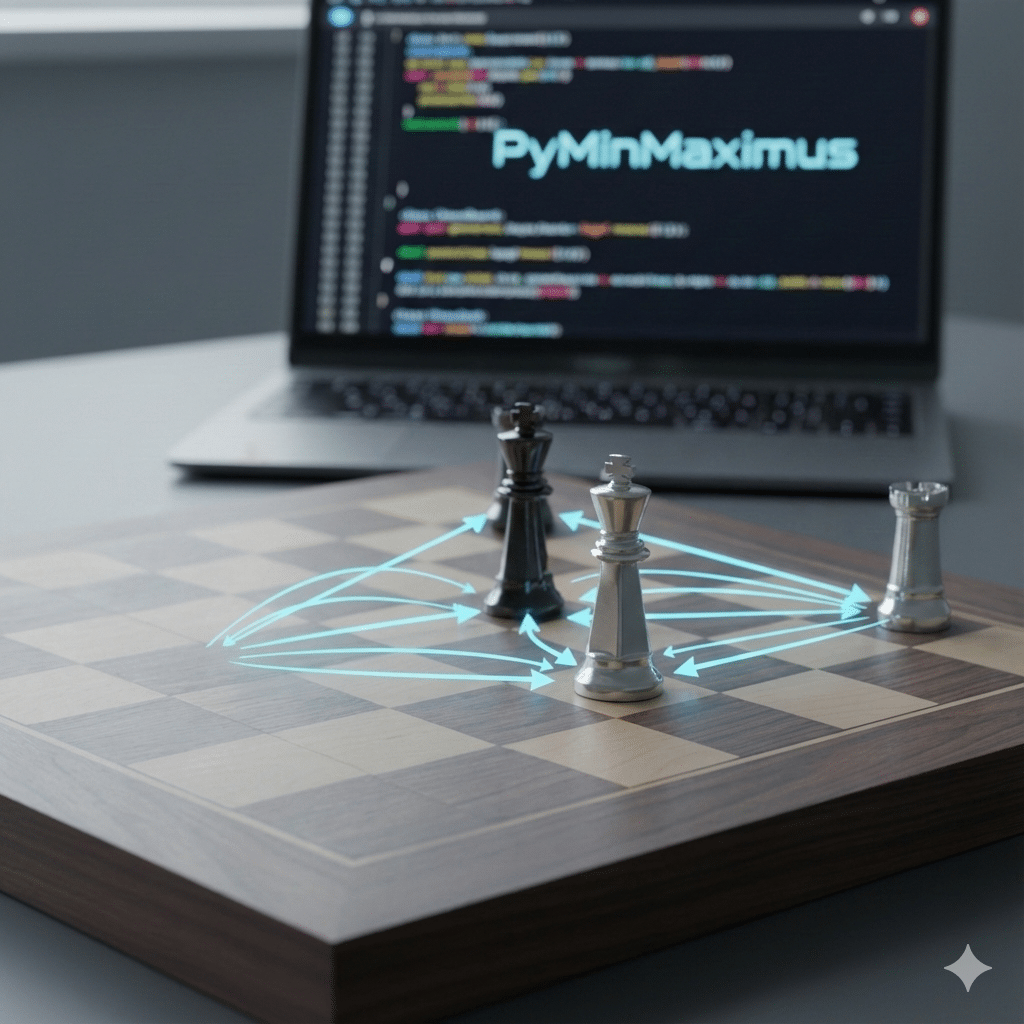
A game tree is a way of visualizing all possible sequences of moves in a game. Each node in the tree represents a position, and each edge represents a move:
                          Current Position
                   /                |          \
                 Move 1           Move 2    Move 3
           /      |       \
       Reply 1  Reply 2  Reply 3
In chess, the tree is enormous. From the starting position:
- Depth 1 (1 ply): 20 possible moves
- Depth 2 (2 ply): 400 possible positions
- Depth 3 (3 ply): 8,902 possible positions
- Depth 4 (4 ply): 197,281 possible positions
This exponential growth is called the branching factor (roughly 35 in chess). We can’t search the entire tree, so we search to a fixed depth and evaluate the resulting positions.
Ply vs. Moves
Important terminology:
- 1 ply = one half-move (one player’s turn)
- 1 move = two plies (both players make a move)
When we say “search to depth 4,” we mean 4 plies, or 2 full moves.
The Minimax Algorithm
Minimax is the foundation of game-playing AI. The idea is elegant:
- Maximizing player (us): We want to maximize our evaluation score
- Minimizing player (opponent): They want to minimize our score
We are assuming both players play optimally. At each level of the tree:
- Our turn: Choose the move with the highest evaluation
- Opponent’s turn: They’ll choose the move with the lowest evaluation (worst for us)
Minimax in Pseudocode
function minimax(position, depth, maximizingPlayer):
    if depth == 0 or game is over:
        return evaluate(position)

    if maximizingPlayer:
        maxEval = -infinity
        for each move in position:
            eval = minimax(move, depth - 1, false)
            maxEval = max(maxEval, eval)
        return maxEval
    else:
        minEval = +infinity
        for each move in position:
            eval = minimax(move, depth - 1, true)
            minEval = min(minEval, eval)
        return minEval
Building a Simple Evaluation Function
Before implementing minimax, we need a way to evaluate positions. For now, we’ll use material count – simply adding up the value of our pieces.
Traditional piece values:
- Pawn = 100
- Knight = 320
- Bishop = 330
- Rook = 500
- Queen = 900
- King = 20000 (effectively infinite)
We can implement this in Python with the following Evaluator class.
# evaluation.py

from constants import *

class Evaluator:
    def __init__(self):
        self.piece_values = {
            PAWN: 100,
            KNIGHT: 320,
            BISHOP: 330,
            ROOK: 500,
            QUEEN: 900,
            KING: 20000
        }

    def evaluate(self, board):
        """
        Evaluate the position from White's perspective.
        Positive = good for White, Negative = good for Black
        """
        score = 0

        for row in range(8):
            for col in range(8):
                piece = board.board[row][col]

                if piece == EMPTY:
                    continue

                piece_type = piece & 7
                color = piece & 24

                value = self.piece_values[piece_type]

                if color == WHITE:
                    score += value
                else:
                    score -= value

        return score

    def evaluate_relative(self, board):
        """
        Evaluate from the perspective of the side to move.
        Positive = good for side to move
        """
        score = self.evaluate(board)
return score if board.to_move == WHITE else -scoreThis simple evaluator just counts material. A position where White is up a queen would score about +900.
Implementing Minimax
Now let’s implement the minimax algorithm:
# search.py

from evaluation import Evaluator

class SearchEngine:
    def __init__(self, board, evaluator=None):
        self.board = board
        self.evaluator = evaluator if evaluator else Evaluator()
        self.nodes_searched = 0

    def minimax(self, depth, maximizing_player):
        """
        Basic minimax search algorithm.
        Returns the evaluation score for the current position.
        """
        self.nodes_searched += 1

        # Base case: reached maximum depth or game over
        if depth == 0:
            return self.evaluator.evaluate_relative(self.board)

        moves = self.board.generate_legal_moves()

        # Checkmate or stalemate
        if len(moves) == 0:
            if self.board.is_in_check(self.board.to_move):
                # Checkmate - return a score that's worse the sooner it happens
                return -20000 + (10 - depth)  # Prefer longer defense
            else:
                # Stalemate
                return 0

        if maximizing_player:
            max_eval = float('-inf')
            for move in moves:
                undo_info = self.board.make_move(move)
                eval_score = self.minimax(depth - 1, False)
                self.board.unmake_move(move, undo_info)
                max_eval = max(max_eval, eval_score)
            return max_eval
        else:
            min_eval = float('inf')
            for move in moves:
                undo_info = self.board.make_move(move)
                eval_score = self.minimax(depth - 1, True)
                self.board.unmake_move(move, undo_info)
                min_eval = min(min_eval, eval_score)
            return min_eval

    def find_best_move(self, depth):
        """
        Find the best move at the root of the search tree.
        """
        self.nodes_searched = 0
        best_move = None
        best_eval = float('-inf')

        moves = self.board.generate_legal_moves()

        if len(moves) == 0:
            return None

        for move in moves:
            undo_info = self.board.make_move(move)
            # We're always maximizing at root (from our perspective)
            eval_score = self.minimax(depth - 1, False)
            self.board.unmake_move(move, undo_info)

            if eval_score > best_eval:
                best_eval = eval_score
                best_move = move

return best_move, best_evalLet’s test this basic minimax:
# Test minimax
from board import Board
from search import SearchEngine

board = Board()
engine = SearchEngine(board)

print("Searching for best move at depth 4...")
best_move, score = engine.find_best_move(4)
print(f"Best move: {best_move}")
print(f"Evaluation: {score}")
print(f"Nodes searched: {engine.nodes_searched:,}")This works, but it’s slow! Even at depth 4, we’re searching more than 200,000 positions. We need optimization.
Alpha-Beta Pruning: Making Minimax Fast
Alpha-beta pruning is a brilliant optimization. The key insight: we can skip searching branches that can’t possibly affect the final decision.
The Concept
Imagine you’re choosing a restaurant.
- Restaurant A: You check reviews and it’s rated 4 stars
- Restaurant B: First review is 1 star
You don’t need to read more reviews of Restaurant B. You are safer choosing Restaurant A, which has all reviews 4 stars or higher. It is possible that Restaurant B has a 5 star review, but it doesn’t matter because you don’t know whether you would get the 1 star experience or the 5 star experience. Therefore, you would choose Restaurant A. You can prune the search.
Alpha-beta works the same way:
- Alpha: The best value the maximizing player can guarantee
- Beta: The best value the minimizing player can guarantee
If we find that a branch can’t improve on what we’ve already found, we skip it.
Alpha-Beta in Code
class SearchEngine:
    # ... previous code ...

    def alphabeta(self, depth, alpha, beta, maximizing_player):
        """
        Minimax with alpha-beta pruning.
        Alpha: best value for maximizer found so far
        Beta: best value for minimizer found so far
        """
        self.nodes_searched += 1

        if depth == 0:
            return self.evaluator.evaluate_relative(self.board)

        moves = self.board.generate_legal_moves()

        if len(moves) == 0:
            if self.board.is_in_check(self.board.to_move):
                return -20000 + (10 - depth)
            else:
                return 0

        if maximizing_player:
            max_eval = float('-inf')
            for move in moves:
                undo_info = self.board.make_move(move)
                eval_score = self.alphabeta(depth - 1, alpha, beta, False)
                self.board.unmake_move(move, undo_info)

                max_eval = max(max_eval, eval_score)
                alpha = max(alpha, eval_score)

                # Beta cutoff
                if beta <= alpha:
                    break  # Prune remaining moves

            return max_eval
        else:
            min_eval = float('inf')
            for move in moves:
                undo_info = self.board.make_move(move)
                eval_score = self.alphabeta(depth - 1, alpha, beta, True)
                self.board.unmake_move(move, undo_info)

                min_eval = min(min_eval, eval_score)
                beta = min(beta, eval_score)

                # Alpha cutoff
                if beta <= alpha:
                    break  # Prune remaining moves

            return min_eval

    def find_best_move_alphabeta(self, depth):
        """
        Find the best move using alpha-beta pruning.
        """
        self.nodes_searched = 0
        best_move = None
        best_eval = float('-inf')
        alpha = float('-inf')
        beta = float('inf')

        moves = self.board.generate_legal_moves()

        if len(moves) == 0:
            return None, 0

        for move in moves:
            undo_info = self.board.make_move(move)
            eval_score = self.alphabeta(depth - 1, alpha, beta, False)
            self.board.unmake_move(move, undo_info)

            if eval_score > best_eval:
                best_eval = eval_score
                best_move = move

            alpha = max(alpha, eval_score)

return best_move, best_evalMove Ordering: Amplifying Alpha-Beta
Alpha-beta pruning works better when we search good moves first. If we find the best move early, we can prune more branches.
Simple move ordering heuristics:
- Captures first (especially captures of valuable pieces)
- Checks (forcing moves)
- Other moves
class SearchEngine:
    # ... previous code ...

    def order_moves(self, moves):
        """
        Order moves to improve alpha-beta pruning.
        Better moves first = more pruning.
        """
        def move_score(move):
            score = 0

            # Get the captured piece (if any)
            captured = self.board.board[move.to_row][move.to_col]

            if captured != EMPTY:
                # MVV-LVA: Most Valuable Victim - Least Valuable Attacker
                captured_value = self.evaluator.piece_values[captured & 7]
                attacker = self.board.board[move.from_row][move.from_col]
                attacker_value = self.evaluator.piece_values[attacker & 7]

                # Prioritize capturing valuable pieces with cheap pieces
                score += captured_value * 10 - attacker_value

            # Prioritize promotions
            if move.promotion:
                score += 800

            # Prioritize checks (we'll need to make the move to check this)
            # For now, we'll skip this to keep it simple

            return score

        return sorted(moves, key=move_score, reverse=True)

    def alphabeta(self, depth, alpha, beta, maximizing_player):
        """
        Alpha-beta with move ordering.
        """
        self.nodes_searched += 1

        if depth == 0:
            return self.evaluator.evaluate_relative(self.board)

        moves = self.board.generate_legal_moves()

        if len(moves) == 0:
            if self.board.is_in_check(self.board.to_move):
                return -20000 + (10 - depth)
            else:
                return 0

        # Order moves for better pruning
        moves = self.order_moves(moves)

        if maximizing_player:
            max_eval = float('-inf')
            for move in moves:
                undo_info = self.board.make_move(move)
                eval_score = self.alphabeta(depth - 1, alpha, beta, False)
                self.board.unmake_move(move, undo_info)

                max_eval = max(max_eval, eval_score)
                alpha = max(alpha, eval_score)

                if beta <= alpha:
                    break

            return max_eval
        else:
            min_eval = float('inf')
            for move in moves:
                undo_info = self.board.make_move(move)
                eval_score = self.alphabeta(depth - 1, alpha, beta, True)
                self.board.unmake_move(move, undo_info)

                min_eval = min(min_eval, eval_score)
                beta = min(beta, eval_score)

                if beta <= alpha:
                    break

return min_evalTransposition Tables: Remembering What We’ve Seen
Chess positions can be reached through different move orders. A transposition table stores positions we’ve already evaluated so we don’t search them again.
class TranspositionTable:
    def __init__(self, size_mb=64):
        # Approximate number of entries based on memory
        self.size = (size_mb * 1024 * 1024) // 100  # rough estimate
        self.table = {}

    def get_hash(self, board):
        """
        Simple hash of the board position.
        In a real engine, we'd use Zobrist hashing.
        """
        return board.to_fen()

    def store(self, board, depth, score, flag):
        """
        Store a position evaluation.
        flag: 'exact', 'lowerbound', or 'upperbound'
        """
        if len(self.table) >= self.size:
            # Simple replacement: clear oldest entries
            self.table.clear()

        hash_key = self.get_hash(board)
        self.table[hash_key] = {
            'depth': depth,
            'score': score,
            'flag': flag
        }

    def probe(self, board, depth, alpha, beta):
        """
        Check if we've seen this position before.
        Returns (found, score) tuple.
        """
        hash_key = self.get_hash(board)

        if hash_key not in self.table:
            return False, 0

        entry = self.table[hash_key]

        # Only use if searched to equal or greater depth
        if entry['depth'] < depth:
            return False, 0

        score = entry['score']
        flag = entry['flag']

        if flag == 'exact':
            return True, score
        elif flag == 'lowerbound':
            if score >= beta:
                return True, score
        elif flag == 'upperbound':
            if score <= alpha:
                return True, score

        return False, 0


class SearchEngine:
    def __init__(self, board, evaluator=None):
        self.board = board
        self.evaluator = evaluator if evaluator else Evaluator()
        self.nodes_searched = 0
        self.tt = TranspositionTable()

    def alphabeta(self, depth, alpha, beta, maximizing_player):
        """
        Alpha-beta with transposition table.
        """
        alpha_orig = alpha

        # Check transposition table
        tt_hit, tt_score = self.tt.probe(self.board, depth, alpha, beta)
        if tt_hit:
            return tt_score

        self.nodes_searched += 1

        moves = self.board.generate_legal_moves()

        if depth == 0 or len(moves) == 0:
            score = self.evaluator.evaluate(self.board)
            return score

        moves = self.order_moves(moves)

        if maximizing_player:
            max_eval = float('-inf')
            for move in moves:
                undo_info = self.board.make_move(move)
                eval_score = self.alphabeta(depth - 1, alpha, beta, False)
                self.board.unmake_move(move, undo_info)

                max_eval = max(max_eval, eval_score)
                alpha = max(alpha, eval_score)

                if beta <= alpha:
                    break

            # Store in transposition table
            if max_eval <= alpha_orig:
                flag = 'upperbound'
            elif max_eval >= beta:
                flag = 'lowerbound'
            else:
                flag = 'exact'
            self.tt.store(self.board, depth, max_eval, flag)

            return max_eval
        else:
            min_eval = float('inf')
            for move in moves:
                undo_info = self.board.make_move(move)
                eval_score = self.alphabeta(depth - 1, alpha, beta, True)
                self.board.unmake_move(move, undo_info)

                min_eval = min(min_eval, eval_score)
                beta = min(beta, eval_score)

                if beta <= alpha:
                    break

            # Store in transposition table
            if min_eval <= alpha_orig:
                flag = 'upperbound'
            elif min_eval >= beta:
                flag = 'lowerbound'
            else:
                flag = 'exact'
            self.tt.store(self.board, depth, min_eval, flag)

return min_evalIterative Deepening: Getting the Best of Both Worlds
Iterative deepening seems wasteful at first: search depth 1, then depth 2, then depth 3, etc. But it has huge benefits:
- Time management: We can stop at any time and have a move
- Move ordering: Information from shallow searches improves deep searches
- Minimal overhead: The deeper searches dominate the cost anyway
class SearchEngine:
    # ... previous code ...

    def iterative_deepening(self, max_depth, time_limit=None):
        """
        Iteratively search to increasing depths.
        """
        import time

        start_time = time.time()
        best_move = None
        best_score = float('-inf')

        for depth in range(1, max_depth + 1):
            # Check time
            if time_limit and (time.time() - start_time) > time_limit:
                break

            self.nodes_searched = 0
            move, score = self.find_best_move_alphabeta(depth)

            elapsed = time.time() - start_time
            nps = self.nodes_searched / elapsed if elapsed > 0 else 0

            print(f"Depth {depth}: {move} (score: {score}) "
                  f"[{self.nodes_searched:,} nodes in {elapsed:.2f}s, "
                  f"{nps:,.0f} nps]")

            if move:
                best_move = move
                best_score = score

            # Stop if we found a mate
            if abs(score) > 19000:
                break

return best_move, best_scoreTesting: Tactical Puzzles
Let’s test PyMinMaximus on some tactical puzzles:
def test_tactics():
    """Test the engine on tactical puzzles."""
    from board import Board
    from search import SearchEngine

    puzzles = [
        {
            'name': 'Mate in 1',
            'fen': 'r1bqkb1r/pppp1Qpp/2n2n2/4p3/2B1P3/8/PPPP1PPP/RNB1K1NR b KQkq - 0 4',
            'solution': None  # Black is already mated
        },
        {
            'name': 'Back Rank Mate',
            'fen': '6k1/5ppp/8/8/8/8/5PPP/3R2K1 w - - 0 1',
            'solution': 'd1d8'  # Rd8#
        },
        {
            'name': 'Queen Fork',
            'fen': 'r1bqkb1r/pppp1ppp/2n5/4p3/2B1n3/5N2/PPPPQPPP/RNB1K2R w KQkq - 0 1',
            'solution': 'e2e5'  # Qxe5+ wins the knight
        },
        {
            'name': 'Smothered Mate',
            'fen': '6rk/6pp/7N/8/8/8/8/R3K3 w - - 0 1',
            'solution': 'h6f7'  # Nf7#
        }
    ]

    for puzzle in puzzles:
        print(f"\n{'='*60}")
        print(f"Puzzle: {puzzle['name']}")
        print(f"FEN: {puzzle['fen']}")
        print('='*60)

        board = Board()
        board.from_fen(puzzle['fen'])

        print(board)

        engine = SearchEngine(board)
        best_move, score = engine.iterative_deepening(6, time_limit=5.0)

        if best_move:
            print(f"\nEngine's choice: {best_move}")
            if puzzle['solution']:
                if str(best_move) == puzzle['solution']:
                    print("✓ CORRECT!")
                else:
                    print(f"✗ Expected: {puzzle['solution']}")
        else:
            print("No legal moves (checkmate or stalemate)")


if __name__ == "__main__":
test_tactics()Performance Comparison
Let’s compare our optimizations:
def benchmark():
    """Compare search algorithms."""
    from board import Board
    from search import SearchEngine
    import time

    board = Board()

    # Test position: complex middlegame
    board.from_fen("r1bq1rk1/ppp2ppp/2np1n2/2b1p3/2B1P3/2NP1N2/PPP2PPP/R1BQ1RK1 w - - 0 8")

    depths = [3, 4, 5]

    for depth in depths:
        print(f"\n{'='*60}")
        print(f"Depth {depth}")
        print('='*60)

        # Basic minimax (without alpha-beta)
        engine1 = SearchEngine(board)
        engine1.tt.table.clear()  # Disable TT
        start = time.time()
        move1, score1 = engine1.find_best_move(depth)
        time1 = time.time() - start
        nodes1 = engine1.nodes_searched

        print(f"Basic Minimax: {nodes1:,} nodes in {time1:.2f}s "
              f"({nodes1/time1:,.0f} nps)")

        # With alpha-beta
        engine2 = SearchEngine(board)
        engine2.tt.table.clear()  # Disable TT
        start = time.time()
        move2, score2 = engine2.find_best_move_alphabeta(depth)
        time2 = time.time() - start
        nodes2 = engine2.nodes_searched

        print(f"Alpha-Beta:    {nodes2:,} nodes in {time2:.2f}s "
              f"({nodes2/time2:,.0f} nps)")
        print(f"Improvement:   {nodes1/nodes2:.1f}x fewer nodes, "
              f"{time1/time2:.1f}x faster")

        # With TT
        engine3 = SearchEngine(board)
        start = time.time()
        move3, score3 = engine3.find_best_move_alphabeta(depth)
        time3 = time.time() - start
        nodes3 = engine3.nodes_searched

        print(f"Alpha-Beta+TT: {nodes3:,} nodes in {time3:.2f}s "
              f"({nodes3/time3:,.0f} nps)")
        print(f"Improvement:   {nodes1/nodes3:.1f}x fewer nodes, "
              f"{time1/time3:.1f}x faster vs basic")


if __name__ == "__main__":
benchmark()Expected results at depth 5:
- Basic minimax: ~3-5 million nodes
- Alpha-beta: ~300k-500k nodes (10x improvement)
- Alpha-beta + TT: ~100k-200k nodes (20-30x improvement)
What We’ve Accomplished
In this post, we’ve built the thinking engine for PyMinMaximus:
✅ Minimax algorithm for optimal move selection
✅ Alpha-beta pruning for 10x+ speedup
✅ Move ordering for better pruning
✅ Transposition tables to avoid redundant searches
✅ Iterative deepening for time management
✅ Tactical puzzle solving at depth 5-6
PyMinMaximus can now play chess! It’s not strong yet – our evaluation function only counts material – but it understands tactics and can find forced wins.
Limitations and Next Steps
Our current engine has some weaknesses:
- Positional blindness: It only sees material, not position quality
- Horizon effect: It can’t see beyond the search depth
- No opening knowledge: Wastes time “thinking” in book positions
- No endgame tablebase: Can’t play simple endgames perfectly
In Part 3, we’ll address the first issue by building a sophisticated evaluation function that understands:
- Piece-square tables for positional play
- Pawn structure (doubled, isolated, passed pawns)
- King safety
- Piece mobility and activity
- Endgame vs. middlegame evaluation
Stay tuned as PyMinMaximus learns the finer points of chess strategy! Missed part 1, click here to learn the basics of building a board and move generation.
Questions or comments? Let me know below! The complete code is available at our GitHub repository. Sign for for our newsletter to be alerted to new posts and to get behind the scenes looks at what we are working on next.