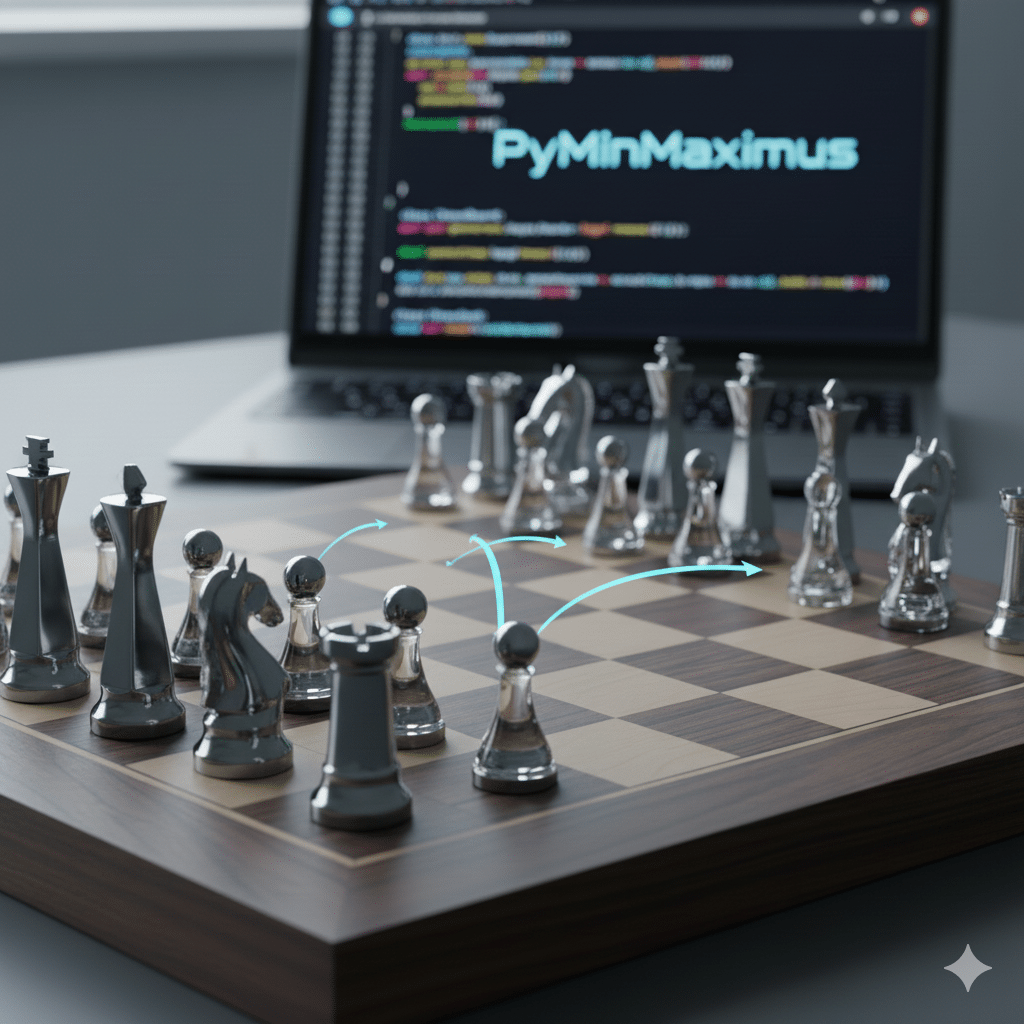
Python is considered too slow for competitive chess engines — and at the grandmaster level, that’s true. But it’s the perfect language for understanding how chess engines work. In this series, we build a functional engine from scratch, explaining every decision along the way.
By the end, PyMinMaximus can play a complete game, interface with chess GUIs via UCI, and handle endgames perfectly for King + Rook vs King positions. It won’t beat Stockfish — but it will beat me, and more importantly, you’ll understand exactly why it makes every move it makes.
What You’ll Build
- A board that tracks piece positions and generates all legal moves
- A minimax search algorithm that looks ahead N moves to find the best play
- Alpha-beta pruning to skip dead-end branches and search deeper
- Position evaluation that scores material and board control
- An opening book and endgame tablebase for perfect play at the edges of the game
- A UCI interface to connect your engine to Arena, Lichess, or any chess GUI
The Series
| Part | Topic | What You Build |
|---|---|---|
| Part 1 | Board Representation | A board that tracks piece positions and generates all legal moves |
| Part 2 | Minimax Search | A search algorithm that looks ahead N moves to find the best play |
| Part 3 | Position Evaluation | Material + positional scoring that teaches the engine chess strategy |
| Part 4 | Opening Book | A database of strong opening moves for the first phase of the game |
| Part 5 | Endgame Tablebase | Perfect endgame play for King + Rook vs King — computed in O(1) time |
| Part 6 | UCI Protocol | Connect your engine to any chess GUI or tournament software |
Who This Is For
This series is for Python developers curious about game AI and search algorithms. No prior chess engine experience required — chess rules are explained as needed. The series assumes Python familiarity but not expertise.
Start with Part 1 → Or, if you just want the code, check out the GitHub repository.
Want updates when new posts are published? Subscribe to the newsletter for tutorial updates, plus occasional posts on Python, electronics, and creative coding.