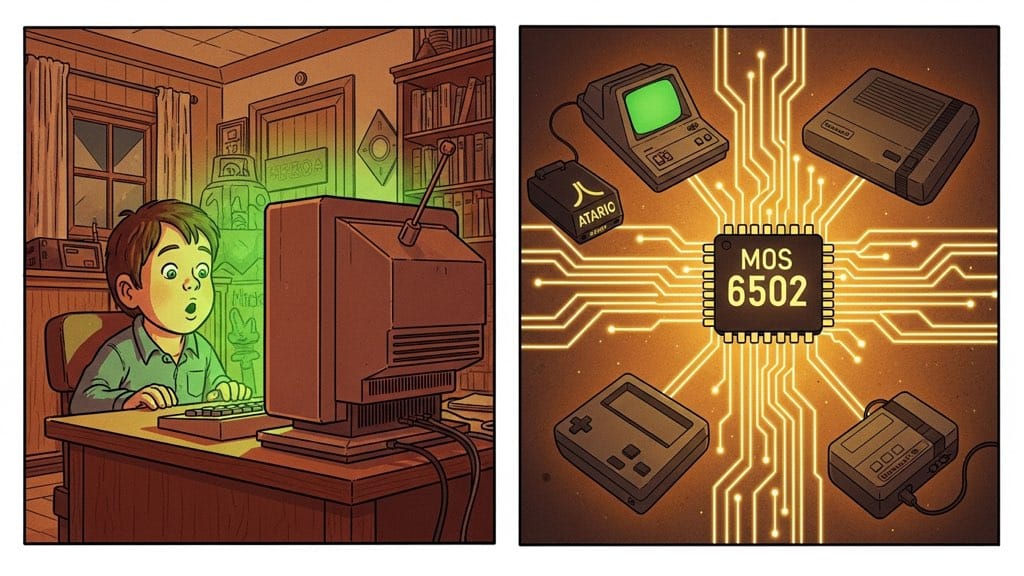
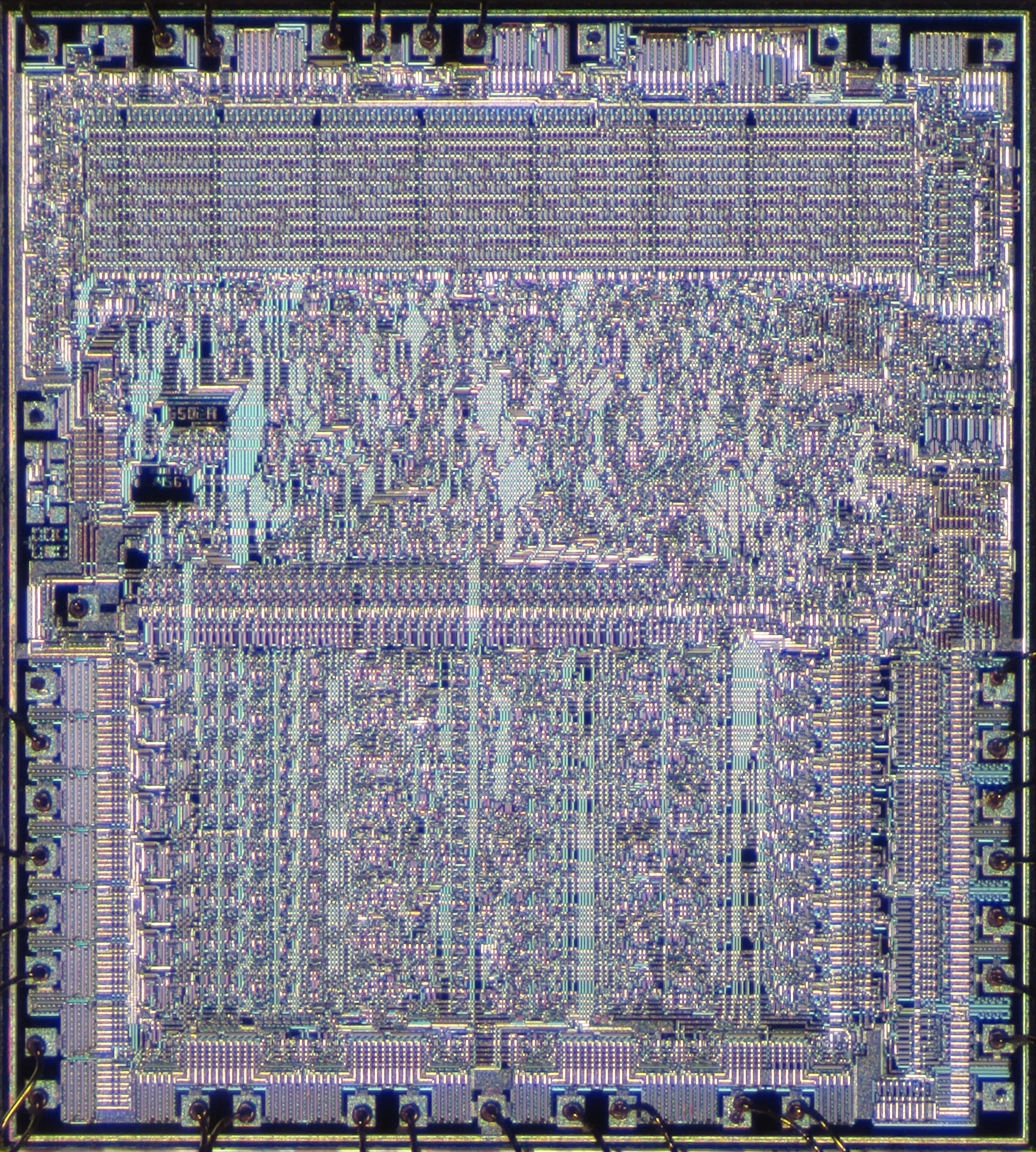
In 1975, a group of engineers quit their jobs at Motorola, drove to a chip design company called MOS Technology, and built a processor that would quietly run inside some of the most important computers and game consoles of the next decade. The chip cost $25. Its competitors cost $150 to $300.
That chip was the MOS 6502. And if you grew up with an Apple II, a Commodore 64, an Atari 2600, or a Nintendo Entertainment System, it was running somewhere near the heart of your machine.
Why Chips Were Expensive in 1975
To understand why the 6502 mattered, you need a feel for what the computing world looked like before it.
Microprocessors — single chips that could act as a computer’s brain — were brand new. Intel’s 8080 and Motorola’s 6800 were the leading options, and they were good chips. They were also expensive, partly because the companies manufacturing them had little reason to compete on price. Microprocessors were sold mostly to engineers and hobbyists with deep pockets. The idea of an ordinary person owning a computer was still science fiction.
The MOS Technology team, led by Chuck Peddle, thought that was backwards. If you could get the price low enough, the market would explode. The question was whether you could build a capable chip cheaply — not by cutting corners, but by being smarter about which features you actually needed.

What Made the 6502 Different
The 6502 wasn’t the most powerful chip of its era. It had fewer registers — the internal storage slots a processor uses to hold data it’s actively working on — than its competitors. Where the Motorola 6800 had two general-purpose accumulators, the 6502 had one.
That sounds like a weakness. But Peddle’s team made a trade: instead of loading the chip with registers, they made accessing memory extremely fast and cheap. If the chip couldn’t hold much internally, it could at least reach out and grab what it needed from RAM with very little delay.
This “zero page” trick — a dedicated region of memory the 6502 could access faster than anywhere else — let programmers compensate for the limited registers. Skilled programmers loved it. The chip rewarded people who understood it.
The result was a processor that was simple, fast for its price, and surprisingly capable in the right hands.
The Machines It Built
Apple II (1977)
Steve Wozniak chose the 6502 for the Apple II partly because it was cheap enough to make a self-contained home computer financially viable, and partly because Wozniak genuinely admired its design. He hand-optimized his code to exploit the chip’s quirks. The Apple II went on to define what a personal computer could be for millions of people, and it ran on a 6502 clocked at just over 1 MHz — barely faster than a ticking metronome by modern standards.
Commodore 64 (1982)
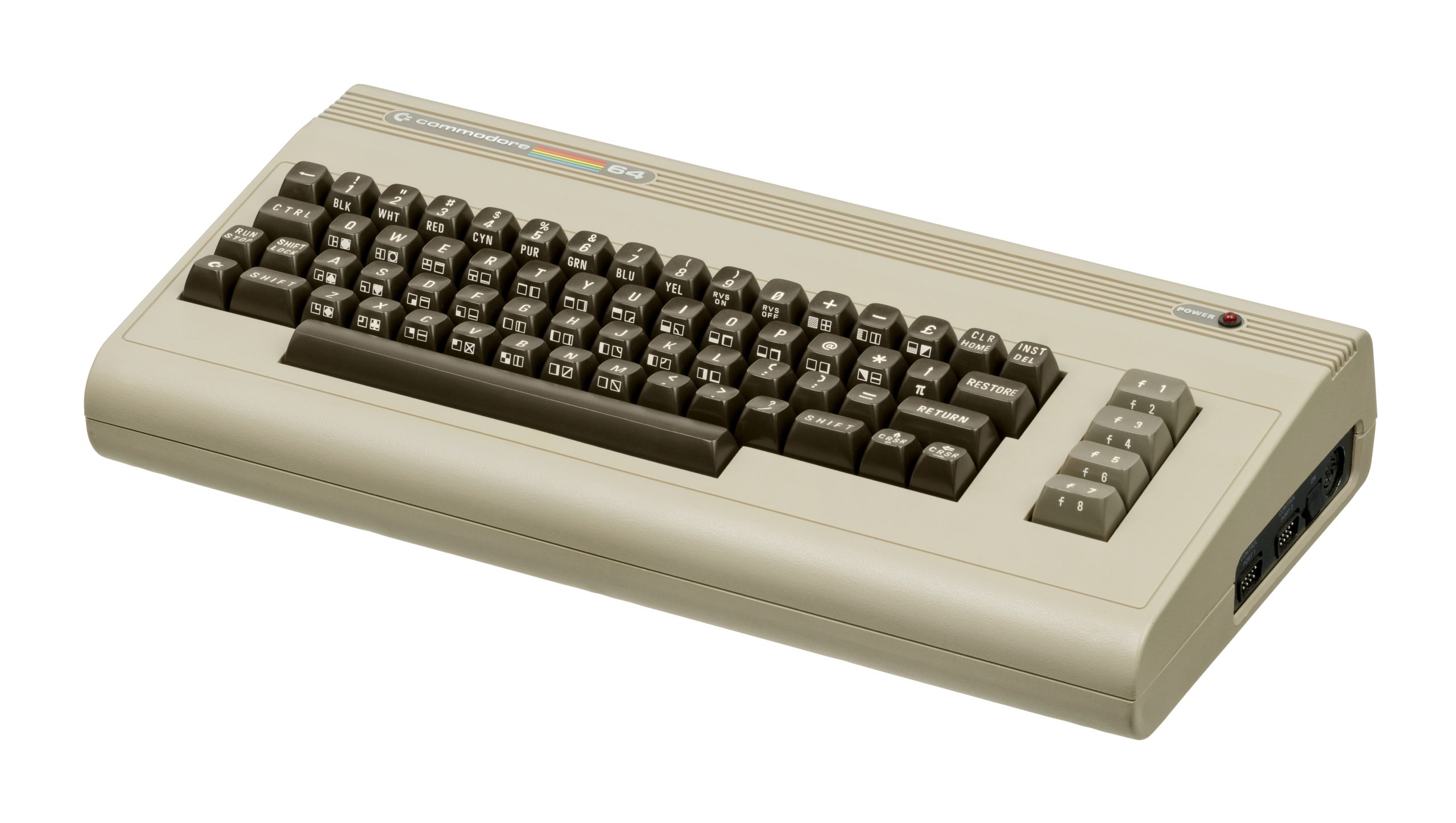
The Commodore 64 used the 6510, a slightly modified 6502 variant. It became the best-selling personal computer model of all time — a record it still holds. The combination of the 6502-based processor, a dedicated sound chip (the SID), and a graphics chip made the C64 a machine that hobbyists and game developers squeezed for every last drop of performance. The demoscene — programmers who compete to create audiovisual effects on constrained hardware — still produces new Commodore 64 demos today.
Atari 2600 (1977)
The 2600 used a 6507, a stripped-down 6502 with a smaller address bus to reduce cost. It had 128 bytes of RAM. Not kilobytes — bytes. Atari 2600 programmers had to write code that generated graphics one scan line at a time, in sync with the TV’s electron beam. The tricks they developed to make colorful, animated games on that hardware are legitimately mind-bending.
Nintendo Entertainment System (1983/1985)
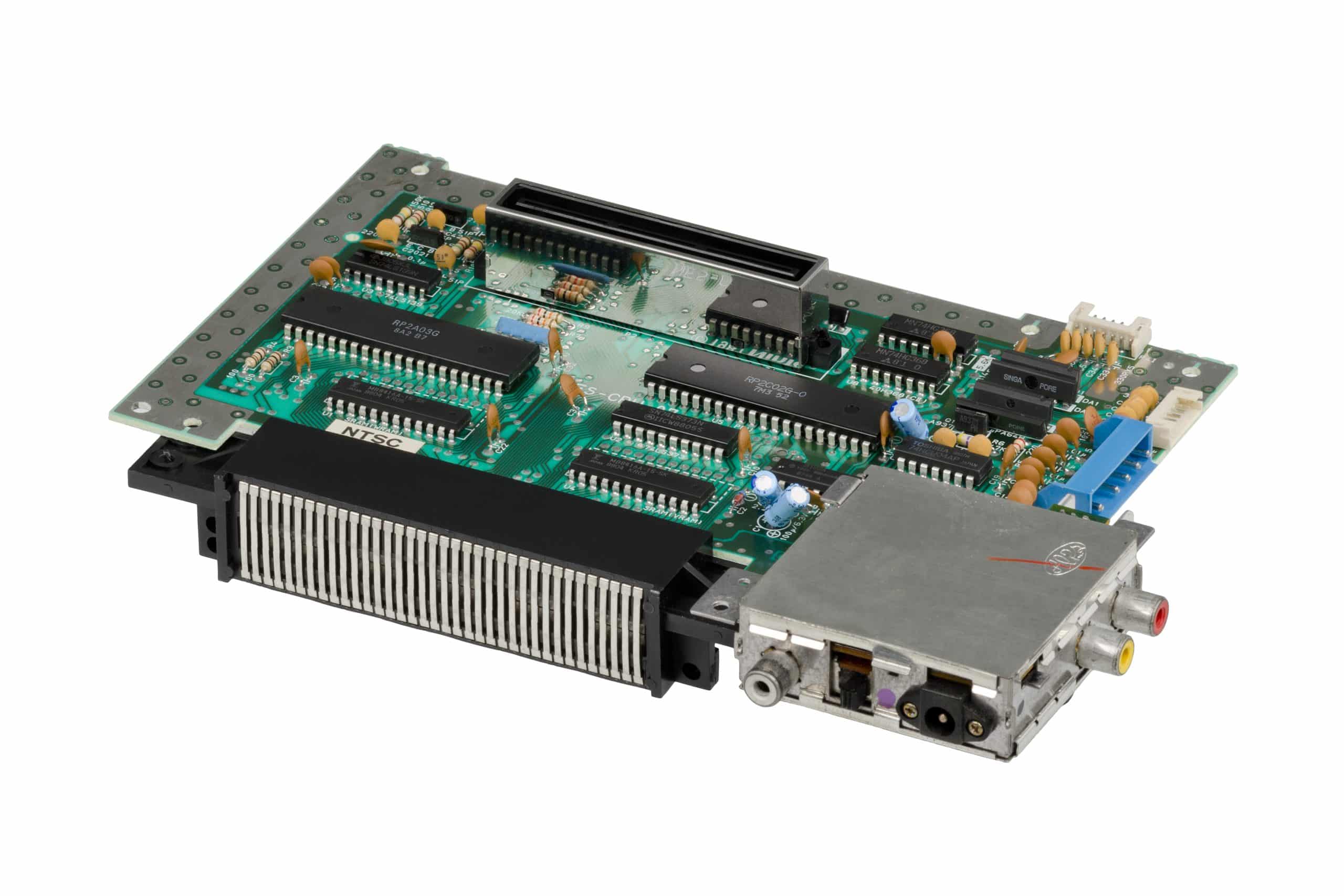
The NES used a Ricoh 2A03, another 6502 variant, this time with the decimal mode disabled (Nintendo didn’t want to pay the patent licensing fee). Despite that quirk, the 6502 architecture powered Super Mario Bros., The Legend of Zelda, Metroid, and much of the defining library of 1980s gaming.
The Same Chip, Wildly Different Machines
Here’s what’s remarkable: these machines had almost nothing in common in terms of what they could do. The Apple II was a productivity and education machine. The Commodore 64 was a music-making, game-playing, home office powerhouse. The Atari 2600 was a living room game console. The NES redefined what video games could be.
All of them, at their core, ran software that ultimately became sequences of instructions the 6502 could execute.
The chip was a kind of common language. Different manufacturers, different applications, different audiences — but the same fundamental architecture underneath. Programmers who learned the 6502 on one machine could apply that knowledge on another. A generation of software developers essentially learned to program on 6502 assembly.
What Happened to It
You might expect the 6502 to have faded into history when faster chips arrived in the mid-1980s. It didn’t — not completely.
The architecture has proven remarkably durable. The 65C02, a low-power CMOS variant, is still in production and used in embedded systems today. Some medical devices, automotive systems, and industrial controllers still run on 6502-compatible chips. The chip is robust, well-understood, and for applications where you don’t need modern performance, still perfectly adequate.
There’s also a thriving community of people who never stopped loving it. The 6502 has detailed, freely available documentation, a decades-deep knowledge base, and a simplicity that makes it an ideal chip for learning how processors actually work. If you’ve ever been curious about assembly language, there are worse places to start.
Why It Still Matters
The 6502 story is really a story about what happens when you challenge an assumption. The assumption in 1975 was that microprocessors were expensive professional tools. Chuck Peddle and his team decided that was a pricing decision, not a technical inevitability.
The $25 chip didn’t just undercut the competition. It helped create an entire industry of people who could afford to own, program, and build with computers. The Apple II put computing in schools. The Commodore 64 put it in living rooms. The NES made it entertainment for an entire generation.
None of that was inevitable. It took a cheap chip, a few bold engineers, and the audacity to think the market could be bigger than anyone imagined.
Curious about what came next? The 6502’s story connects directly to how early game developers pulled off the impossible on constrained hardware — perhaps something we will explore in the future.