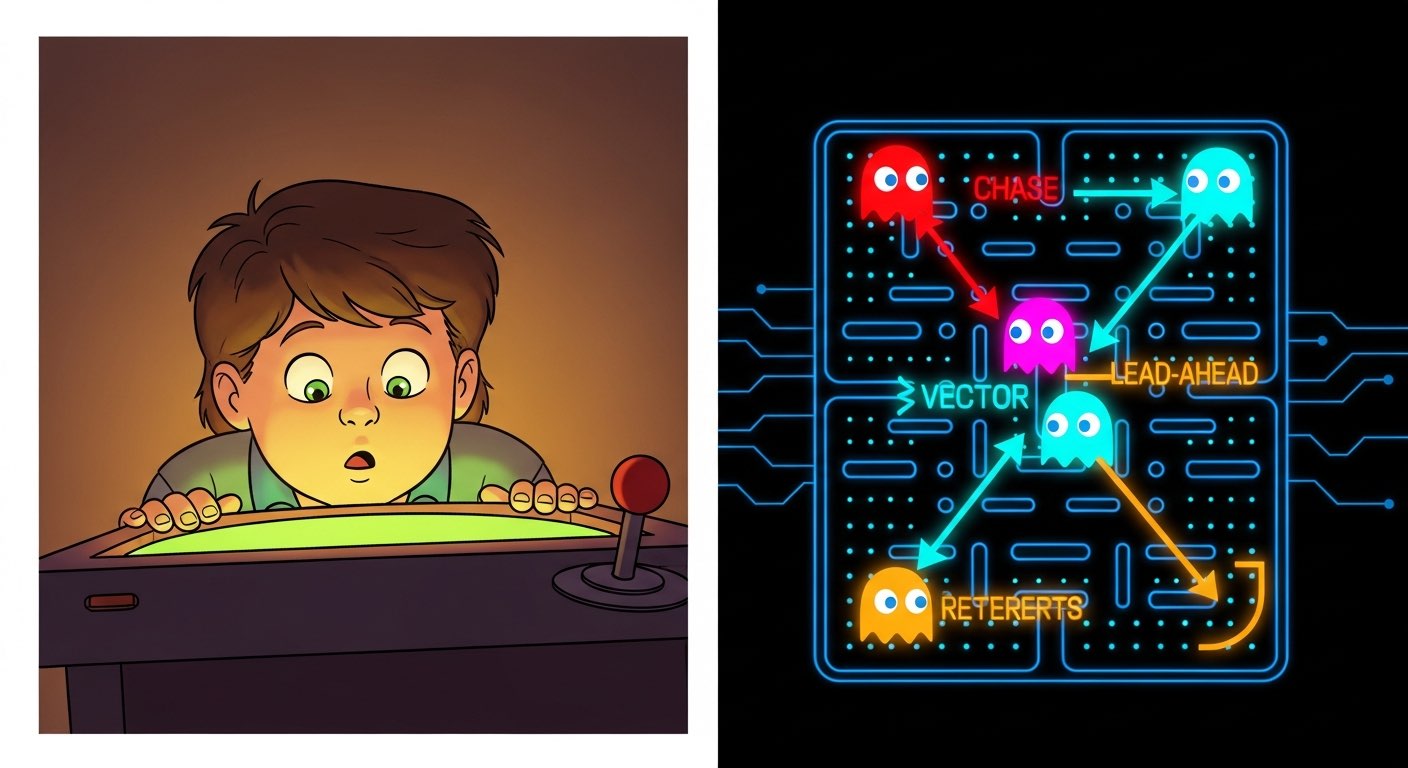
Here’s something that changes the way you’ll play Pac-Man forever: the ghosts aren’t trying to surround you by accident. They’re doing it on purpose. Each one follows a different set of rules — rules that were carefully designed to push you toward the edges of the maze and pin you there.

Blinky chases. Pinky cuts you off. Inky is unpredictable in a very deliberate way. And Clyde? Clyde is actually afraid of you.
All of this runs on hardware with roughly 2KB of RAM and a processor slower than a wristwatch. Let’s look at how it works.
The Three Moods of Every Ghost
Before we get into personalities, every ghost operates in one of three modes at any given moment.
Chase mode is what you’d expect — the ghosts are hunting. Each one does this differently, which we’ll get to.
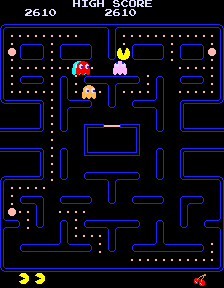
Scatter mode kicks in periodically throughout the game. When it does, each ghost stops hunting and retreats to a fixed corner of the maze — Blinky to the upper right, Pinky to the upper left, Inky to the lower right, Clyde to the lower left. They just loop around their corner like they’ve forgotten you exist. Scatter mode lasts only a few seconds, but it’s your window to breathe, reposition, and grab dots safely.
The game alternates between scatter and chase mode on a fixed timer, cycling faster as the game progresses. Early in a level you get generous scatter breaks. By the second level, the fourth scatter period has shrunk to a single frame — effectively nothing. The reduction continues from there.
Frightened mode happens when you eat a power pellet. Ghosts turn blue, slow down, and scatter in random directions — now you’re the predator. They remember nothing during frightened mode; their personalities are completely suspended.
The interesting behavior — the part that makes Pac-Man feel different from every other arcade game of its era — happens in chase mode.
Blinky: The Honest Pursuer
Blinky is the red ghost, and he plays it completely straight. His target is always your current tile. Every update cycle, he calculates the shortest path toward wherever you are right now and moves in that direction.
This makes Blinky predictably dangerous. The longer you stay in one area, the more directly he converges on you. He’s also the ghost that gets released from the ghost house first, so he’s on you earliest.
There’s one additional wrinkle: Blinky has a hidden gear. As you eat more dots, his speed gradually increases. Clear a certain threshold of the maze and he enters what players call “Cruise Elroy” mode — his scatter behavior is disabled entirely and he chases you even during scatter phases. (Where the name comes from, nobody knows. It’s community terminology with no documented origin.) The more dots you eat, the faster he gets.
This is a brilliant difficulty mechanic. The more successful you are at clearing the maze, the more dangerous Blinky gets. The game punishes greed.
Pinky: The Ambusher
Pinky doesn’t go where you are. She goes where she thinks you’ll be.
Her target is the tile four squares ahead of Pac-Man’s current direction of travel. If you’re moving right, she’s aiming for a point four tiles to your right. If you’re moving up — well, we’ll get to that in a moment.
The intent is to have Pinky cut off escape routes. If Blinky is chasing you from behind and Pinky is targeting your path ahead, you’re being pinched. This is exactly what the designers intended: Blinky and Pinky were meant to work as a pair, with Blinky flushing you toward wherever Pinky is waiting.
In practice, Pinky is dangerous when you move in long straight lines. She’s also the reason experienced players develop the habit of making quick direction changes — it throws off her lead calculation entirely.
The famous Pinky bug: When Pac-Man faces upward, a quirk in the original code causes Pinky’s target to be four tiles up and four tiles to the left simultaneously. This is a bug — the result of how the game represents “up” direction in memory and an integer overflow. It means Pinky behaves slightly differently when you’re moving upward than in any other direction. The original arcade code was never fixed, so this behavior became part of the game’s DNA. Every authentic Pac-Man implementation preserves it.
Inky: The Wild Card
Inky is the cyan ghost, and he has the most complicated targeting logic of the four. Understanding him requires knowing where both you and Blinky are at the same time.
Here’s how it works:
- Find the tile two squares ahead of Pac-Man’s current direction (his “reference point”)
- Draw an imaginary line from Blinky’s current position to that reference point
- Double the length of that line
- Whatever tile you land on is Inky’s target
The result is a ghost whose behavior depends entirely on context. When Blinky is far away, Inky behaves somewhat like Pinky — targeting ahead of you. When Blinky is close and behind you, Inky’s target swings out wide, flanking from a completely different angle.
This is genuinely clever design. Inky doesn’t just add a third chaser — he creates emergent complexity. His behavior changes based on the positions of two other entities, which means the “danger zone” shifts constantly in ways that are hard to internalize. He’s the ghost that catches experienced players off guard, because his path isn’t predictable the way Blinky’s or Pinky’s is.
Clyde: The Coward
Clyde is orange, released last from the ghost house, and widely misunderstood. Many players assume he’s broken, or dumb, or just wandering aimlessly.
He’s actually afraid of you.
Clyde’s logic has two phases. When he’s more than eight tiles away from Pac-Man, he behaves exactly like Blinky — targeting your current position and chasing directly. But the moment he closes within eight tiles, his behavior flips completely. He abandons the chase and retreats to his scatter corner in the lower left of the maze.
The result is a ghost that perpetually fails to catch you. He approaches, gets close, loses his nerve, and runs away — only to circle back from a distance and start the whole process again.
This makes Clyde feel unpredictable to new players. He seems to drift around the bottom-left quadrant without purpose. But there’s a purpose: he’s actually very useful for farming points if you understand his eight-tile threshold, because you can dance near him while he yo-yos back and forth.
The name “Clyde” was part of a broader naming convention — in Japan, the ghosts had their own names (Akabei, Pinky, Aosuke, Guzuta) and were each described by a personality type: Oikake (chaser), Machibuse (ambusher), Kimagure (whimsical), and Otoboke (fool). The American localization gave them the names Blinky, Pinky, Inky, and Clyde, and added the personality descriptions “Shadow,” “Speedy,” “Bashful,” and “Pokey.” The personalities held. The names are part of gaming history.
How the Targeting Actually Works
The ghosts don’t use pathfinding in the way you might imagine. They don’t calculate a full route through the maze and follow it. Instead, at every intersection, each ghost looks at its current target tile and asks a simple question: which of my available turns gets me closest to that tile?
That’s it. They use straight-line distance — not maze distance — to evaluate each possible direction, then take the turn that minimizes that distance. This is called a greedy approach: take the locally best option at each step without planning ahead.
This has a fascinating consequence: ghosts can’t reverse direction except when their mode switches (chase to scatter, scatter to chase). The reversal rule is actually enforced because without it, a ghost using purely greedy movement would get trapped in dead ends and oscillate. Forcing a reversal on mode switches lets them escape and approach from new angles.
The simplicity of this logic is exactly why it runs on 1980 arcade hardware. There’s no complex pathfinding, no memory of previous positions, no simulation of multiple futures. Just: where’s my target? Which way gets me closer? Turn.
Why This Still Matters
Modern game designers study Pac-Man’s ghost AI not because it’s technically sophisticated — it isn’t — but because it achieves something genuinely difficult: four enemies that feel distinct, create emergent cooperation without any communication between them, and scale in difficulty without changing the underlying rules.
The “cooperation” between Blinky and Pinky isn’t programmed. It emerges from their independent targeting rules interacting in space. Inky’s unpredictability isn’t random — it’s geometric complexity arising from a simple formula. Clyde’s cowardice isn’t a flaw; it’s a deliberate personality that makes the lower-left corner of the maze feel different from everywhere else.
This is the kind of design insight that shows up in every discussion of enemy AI — in platformers, in real-time strategy games, in modern action games with complex behavior trees. The lesson from 1980 is still current: constraints force clarity, and clarity produces systems that are endlessly interesting to play against.
If this sparked your curiosity, Toru Iwatani — Pac-Man’s designer — has talked in interviews about his original vision of a game about eating, designed to appeal to people who didn’t typically play arcade games. Dig into those interviews. The gap between his original sketches and the finished game is remarkable.