Here’s a strange fact: on the day Nintendo’s Game Boy went on sale in Japan — April 21, 1989 — it was already outclassed by the competition.
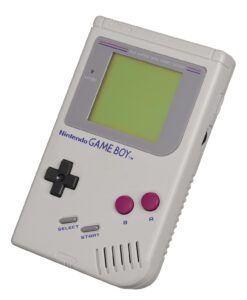
Its screen was a blurry greenish-gray. No backlight. No color. Its processor was slower than what you’d find in a budget home computer. A rival handheld launched the same year with a full-color backlit display, stereo sound, and a faster chip. By every spec-sheet metric, the Game Boy looked like yesterday’s hardware selling alongside tomorrow’s.
It went on to sell over 118 million units. The rival is a trivia question.
So what happened? The answer turns out to be one of the most elegant lessons in product design ever demonstrated — and it came from a man who believed that the newest technology was almost never the right technology.
The Competition Looked Like the Future
To understand what made the Game Boy’s success so counterintuitive, you have to understand what else was on the market.
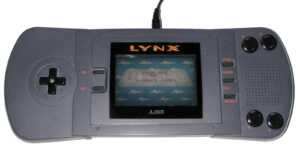
The Atari Lynx launched the same year, in 1989. It had a backlit color LCD screen — a genuine rarity at the time. It could display 16 colors simultaneously from a palette of 4,096. It had hardware sprite scaling, which let the processor zoom and shrink graphics smoothly — something the Game Boy simply couldn’t do. It had stereo sound. It was, by almost any technical measure, a more impressive piece of engineering.
A year later, Sega released the Game Gear. Also color, also backlit, also technically superior in most respects. It could even play Sega Master System cartridges with an adapter, giving it an instant library.
Meanwhile, the Game Boy’s screen was so dim and low-contrast that playing in anything other than direct sunlight meant squinting at a smear of olive-colored pixels. Fast-moving objects left ghostly trails across the display — a hardware limitation that reviewers noted immediately.
On paper, Nintendo had brought a knife to a gunfight.
The Man Behind the Decision
The Game Boy was designed by Gunpei Yokoi, a Nintendo engineer who had spent his career thinking about games in unusual ways. Yokoi is one of the most important people in gaming history, and also one of the least famous — at least outside Japan.
He started at Nintendo in 1965, working on the factory floor maintaining machines. One day, Nintendo’s president spotted him playing with a toy he’d made himself from parts he found at the factory — an extendable arm that could grip objects at a distance. The president ordered it into production. It sold more than a million units.
Yokoi went on to create the Game & Watch series, the iconic D-pad (used on virtually every gamepad since), and eventually, the Game Boy. His guiding philosophy had a name: Lateral Thinking with Withered Technology.
The idea was deliberately counterintuitive. Instead of chasing the cutting edge, Yokoi argued for using mature technology — hardware that was fully understood, cheap to manufacture, and proven to be reliable — but applying it in new or unexpected ways. The goal wasn’t to impress engineers. It was to delight people.
Why “Withered” Technology Won
Here’s where the Game Boy’s apparent weaknesses become its actual strengths.
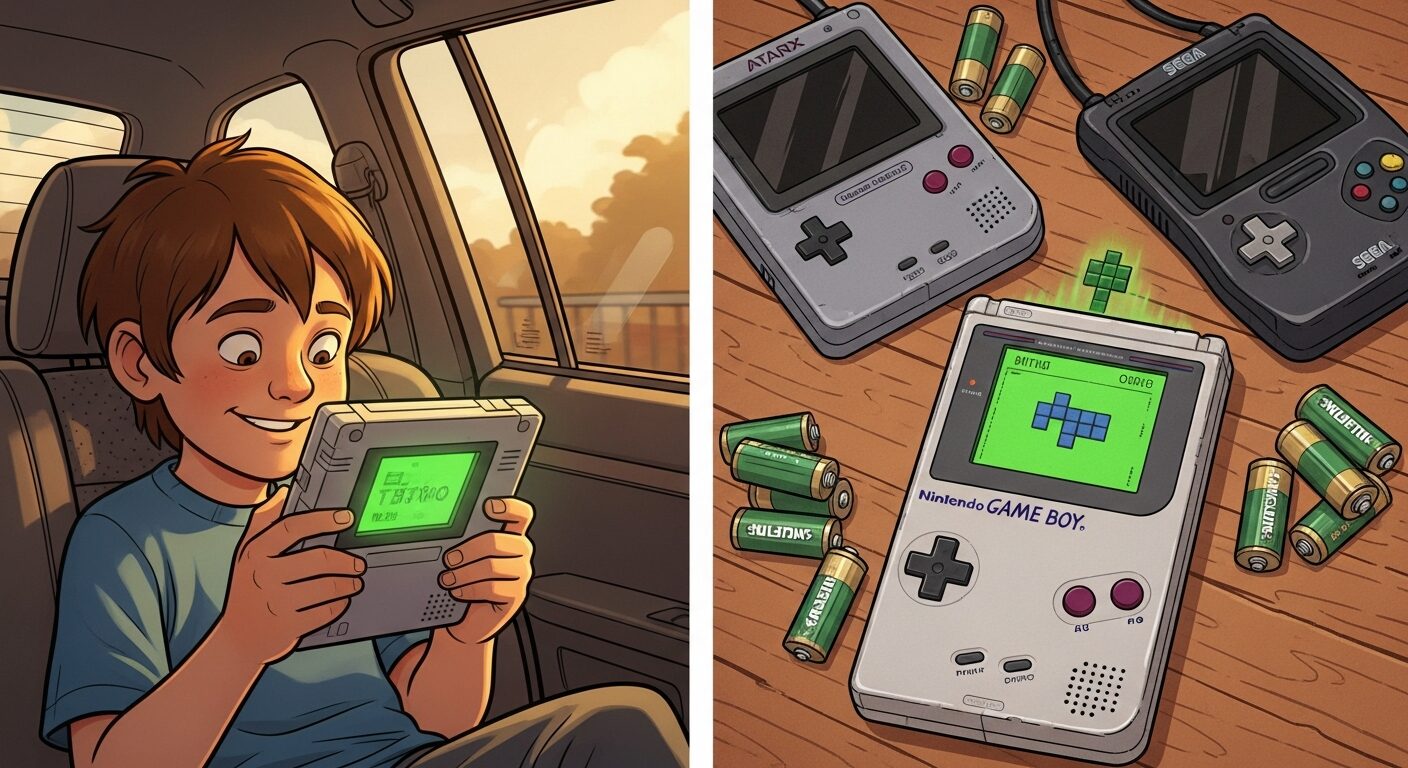
Battery life. The Atari Lynx, with its color backlit display, chewed through six AA batteries in four to six hours. The Game Gear was even worse — three to five hours on six AAs, and it ran hot in your hands. The Game Boy used four AA batteries and lasted anywhere from fifteen to thirty hours. For a kid on a long car trip, this wasn’t a minor convenience. It was the entire product.
Price. The Game Boy launched at $89.99 in the US. The Lynx was $179.95. The Game Gear would launch at $149.99 as well. A $60–$90 difference was enormous in 1989 — that was the cost of another game or two, or for many families, the difference between buying one for a child’s birthday or not.
Durability. The Game Boy was a brick in the best possible sense. It could be dropped, sat on, stuffed in a backpack. The color rivals had more delicate screens and more complex hardware with more points of failure. Nintendo engineered the Game Boy to survive childhood.
The library. Nintendo launched the Game Boy with Tetris bundled in. This deserves its own appreciation: Tetris is arguably the single most perfectly suited game for short, interruptible play sessions ever created. It was a masterclass in matching product to use case. By the time Sega and Atari had their hardware in stores, Nintendo had a library; by the time that library grew, the Game Boy was the default answer to “what handheld should I buy?”
None of these advantages showed up in a spec comparison. All of them showed up the moment a real person tried to actually use the device.
The Specs Were Never the Point
This is the part of the story that gets lost when people compare hardware.
Yokoi understood something that seems obvious in retrospect but was apparently invisible to Nintendo’s competitors: a portable gaming device isn’t competing against a home console. It’s competing against boredom. Against the backseat of a car, a doctor’s waiting room, a lunch break. The question isn’t “how impressive is the hardware?” The question is “will this thing be on and playable in five seconds, for fifteen hours, without needing a wall outlet?”
The Lynx’s color screen was breathtaking indoors. Outdoors, in the sunlight where kids actually played, it washed out completely. The Game Boy’s reflective display, which critics called dim, worked best in exactly the conditions where children actually played — bright ambient light, outdoors, in the sun. Whether that was an explicit design choice or a side effect of using mature, affordable display technology hardly matters. The result was the same.
The rivals optimized for the demo. Nintendo optimized for the Tuesday afternoon.
What Happened to the Competition
The Atari Lynx was discontinued in 1995 after selling an estimated one to three million units — official figures were never published. The Game Gear lasted until 1997, selling around fourteen million — a respectable number on its own, but a fraction of what the Game Boy achieved.
The Game Boy line, including the Game Boy Color released in 1998, continued until 2003. Its spiritual successor, the Game Boy Advance, sold 81 million units on its own. The DS, which inherited the same design philosophy of accessible portable play over raw power, sold 154 million.
Gunpei Yokoi left Nintendo in 1996, following the commercial failure of the Virtual Boy — a 3D headset that was, ironically, a case of chasing novel technology rather than applying mature technology wisely. He died in a car accident in 1997, before he could see how completely his philosophy had been vindicated.
Why This Still Matters
You might think this is ancient history — 8-bit screens and AA batteries. But the Game Boy story keeps repeating.
In 2004–2005, Sony launched the PSP: powerful, beautiful, technically superior to Nintendo’s DS in almost every way. The DS had two screens, one of them a touchscreen, and a processor that looked like a toy by comparison. The DS outsold the PSP by roughly two to one.
In 2017, the Nintendo Switch launched with specs that GPU enthusiasts found underwhelming. It sold 150 million units and counting.
The pattern holds. The question was never the specs. It was always: what does this feel like to actually use?
Gunpei Yokoi figured that out in 1989 with a greenish-gray screen and four AA batteries. The lesson, apparently, is still worth learning.
The Game Boy’s Sharp LR35902 processor — the chip at its heart — is itself a fascinating piece of engineering history: a hybrid between the Intel 8080 and Zilog Z80 architectures that was custom-built for Nintendo’s needs. If you want to go deeper, look up the open-source Game Boy emulator community: they’ve reverse-engineered the hardware down to the cycle level, and the documentation they’ve produced is remarkable.
Want to see what else is happening at harlepengren.com? Kirk covers Python, chess engines, game development, and maker projects — subscribe to The Monthly Dispatch for a roundup of what’s new.